
Country Profiles
Uganda
 Uganda
The Republic of Uganda is located in East-Central Africa and it is bordered by Kenya, South Sudan, Democratic Republic of Congo, Rwanda and Tanzania. The population of Uganda is 43 million and its GDP is $25 Billion.
Uganda gained independence from the United Kingdom in 1962 and the current constitution is effective since 1995. English and Swahili are the official languages. Its capital city is Kampala with a population of around 1.5 million people. The country has faced civil wars and conflicts since its independence. The current president came to power in 1986 after a guerilla war.
Uganda’s main import and export partners are China and the United Arab Emirates. Uganda also has strong commercial relations with its border countries. It exports 45% of its products to African countries. Uganda’s economy is driven by agriculture and gold mining. Coffee constitutes 20% of all exports, while gold constitutes 15%.
Turkish Embassy in Uganda was opened very recently in 2010. Since that time, the political and commercial relations developed quickly. Turkish companies have been looking for business opportunities in Uganda, and Turkish Exporters’ Assembly organized the Turkey-Uganda Businss Forum in 2017. Uganda is expected to extract petroleum in 2020 and Turkish companis can find opportunities in the machinery and construction sector.
Below, you can see the fact sheet, macroeconomic outlook and trade relations of Uganda with Turkey.

Country at a glance
- Capital city
- Kampala
- Official language
- English / Swahili
- Population
- 43 million
- GDP
- $25 billion
- GDP per capita
- $604
- Human Development Index
- 0.516
- Top 3 import partners
- China, India, UAE
- Top 3 export partners
- UAE, Kenya, S. Sudan
- Top 3 import products
- Refined Petroleum, Packaged Medicaments, Palm Oil
- Top 3 export products
- Gold, Coffee, Raw Tobacco
- Trade balance
- -$3.05B in net imports
Source: Istanbul Africa Trade Company, Africa Economic Report (2019). Figures as published, reflecting data to 2017.
Uganda: practical trade guide
What a shipment between Turkey and this market needs, how the goods get there, and what to settle before you sign.
- Gateway ports (landlocked)
- Mombasa, Dar es Salaam
- Currency
- Ugandan shilling (UGX)
- Trade blocs
- AfCFTA, EAC, COMESA
- Trade agreement with Turkey
- None in force: standard duties generally apply
Specific to Uganda
- Regulated products need a Certificate of Conformity under the UNBS Pre-Export Verification of Conformity (PVoC) programme, issued in Turkey by an appointed inspection body before shipment. Requests go through the Uganda Electronic Single Window.
Standard documents
- Commercial invoice and packing list
- Bill of lading or air waybill
- Certificate of origin issued by a Turkish chamber of commerce
- Insurance certificate when the Incoterm includes insurance (CIF, CIP)
Before you sign
- Check the counterparty: registration, activity and references
- Match the payment structure to the risk: advance or partial payment, documentary collection or a letter of credit
- Confirm whether your product needs a certificate or registration in this market before production starts
Reviewed October 2026. Requirements change: confirm the current rules for your product with your forwarder, the buyer's customs broker or us before shipping.
Turkey's exports to this market
Source: Istanbul Africa Trade Company, Africa Economic Report. Figures as published.
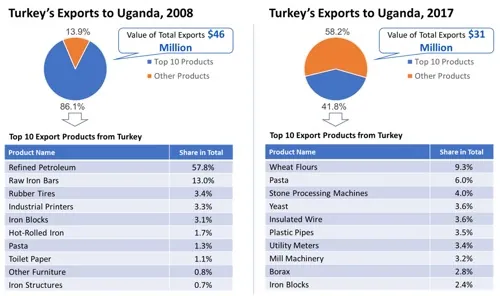
2008
$46 million
Top 10 products account for 86.1% of the total.
| Product | Share of total |
|---|---|
| Refined Petroleum | 57.8% |
| Raw Iron Bars | 13% |
| Rubber Tires | 3.4% |
| Industrial Printers | 3.3% |
| Iron Blocks | 3.1% |
| Hot-Rolled Iron | 1.7% |
| Pasta | 1.3% |
| Toilet Paper | 1.1% |
| Other Furniture | 0.8% |
| Iron Structures | 0.7% |
2017
$31 million
Top 10 products account for 41.8% of the total.
| Product | Share of total |
|---|---|
| Wheat Flours | 9.3% |
| Pasta | 6% |
| Stone Processing Machines | 4% |
| Yeast | 3.6% |
| Insulated Wire | 3.6% |
| Plastic Pipes | 3.5% |
| Utility Meters | 3.4% |
| Mill Machinery | 3.2% |
| Borax | 2.8% |
| Iron Blocks | 2.4% |
Frequently asked questions
- Uganda: what does Turkey export there?
- In 2017, Turkey's exports to this market were valued at $31 million. The ten largest product groups made up 41.8% of that total, led by Wheat Flours; Pasta; Stone Processing Machines.
- Uganda: who are its main trading partners?
- The three largest import partners are China, India, UAE. The three largest export partners are UAE, Kenya, S. Sudan.
- Uganda: what does the country import?
- The three largest import products are Refined Petroleum; Packaged Medicaments; Palm Oil. The three largest export products are Gold; Coffee; Raw Tobacco.
- Uganda: how big is the economy?
- Population 43 million, GDP $25 billion, and $604 per person. The Human Development Index is 0.516.
- Uganda: does it run a trade surplus or a deficit?
- The trade balance is -$3.05B in net imports.
- Uganda: how do goods from Turkey reach it?
- Uganda is landlocked. Goods from Turkey usually arrive through Mombasa, Dar es Salaam and continue by road or rail under transit procedures.
- Uganda: what does a shipment from Turkey need beyond the standard documents?
- Regulated products need a Certificate of Conformity under the UNBS Pre-Export Verification of Conformity (PVoC) programme, issued in Turkey by an appointed inspection body before shipment. Requests go through the Uganda Electronic Single Window.
- Uganda: do Turkish goods get a preferential duty rate?
- Not under a bilateral agreement: Turkey's free trade agreements in force in Africa cover Morocco, Tunisia and Egypt. Standard duties generally apply, and AfCFTA preferences cover goods of African origin, not Turkish goods.
Related reading
Exporting from Turkey to Uganda: A Practical Guide
A practical guide to exporting from Turkey to Uganda: the documents, the shipping route through Mombasa or Dar es Salaam, the regulations, and the...
Turkish Construction Materials in Africa: A Seller's Guide
A practical look at selling Turkish construction materials in Africa: the products that sell, the markets that buy them, what the 2017 trade data...
Verifying an African Mineral Supplier Before You Pay
Verifying an African mineral supplier before you pay is simpler than it looks: confirm the company, the licence and the material, and tie every...
- Importing Timber from Africa: A Buyer's Guide to Forestry Products
- Importing Cotton from Africa for Turkish Textile Mills
- Green Coffee Contract Terms for Turkish Coffee Roasters
- Verifying a Cocoa Supplier in Ghana or Ivory Coast
- Sourcing Agricultural Products from Africa for Turkish Buyers
- How to Start Exporting from Turkey to Zambia: A Practical Guide
- How to Start Exporting from Turkey to Cameroon: A Practical Guide
- How to Start Exporting from Turkey to Algeria: A Practical Guide
- How to Start Exporting from Turkey to Zimbabwe: A Practical Guide
Other country profiles
- Buying from Turkey for Uganda?How we find and check Turkish manufacturers and secure your terms before you pay.For African importers
- Exporting from Turkey to Uganda?Exporting from Turkey to Uganda: A Practical GuideRead the route guide
Reviewed by Burak Unal, Director of African Markets